
DNA Testing for Gut Health: What Your Genes Can Tell You That Symptoms Can't
- Jul 15
- 5 min read
Updated: Jul 16

For most of modern medicine, we've understood one simple truth: no two people have exactly the same DNA.
We readily accept that our genes influence everything from our eye colour and height to the way we process medications and our susceptibility to certain diseases. Increasingly, medicine is recognising that our genetic differences also influence how we respond to treatment.
Yet when it comes to gut health, we often seem to forget this.
Open almost any article on bloating, reflux or IBS and you'll find broadly the same advice. Remove certain foods. Add probiotics. Increase fibre. Reduce stress. Take digestive enzymes. Support your microbiome.
Much of that advice is valuable.
But almost all of it rests on the same assumption: that if two people have similar symptoms, they should respond to similar treatments.
I don't think that's always true.
In fact, I think it's one of the reasons so many people spend years moving from one diet, supplement or protocol to another without ever understanding why something that transformed another person's gut had little effect on their own.
The missing piece may not be another supplement. It may be the biology that has been shaping their gut all along.
Your microbiome doesn't exist independently of you
Over the past decade we've learnt an extraordinary amount about the gut microbiome. We know the microbes living within us influence digestion, immunity, metabolism and even brain function.
What's discussed less often is that the microbiome is only half the story. Those microbes don't exist in isolation. They develop within a genetically unique human being.
Our genetic makeup, together with environmental factors such as diet, stress, medications and lifestyle, helps shape the microbiome's composition, diversity and function over a lifetime.
Our genes also influence many of the biological systems that underpin digestive health, including immune regulation, inflammatory responses, gut barrier integrity, gut motility, nutrient metabolism and gut-brain communication. Together, these systems help determine how resilient our digestive system is and how it responds to change.
Imagine two people with almost identical symptoms following exactly the same treatment plan. One improves dramatically. The other notices very little difference. It's tempting to assume the second person simply hasn't found the right supplement. Another possibility is that their biology simply works differently.
Genes aren't your destiny. They're your blueprint.
One of the biggest misconceptions about genetic testing is that it predicts your future.
In reality, most clinically useful genetic testing isn't about identifying disease. It's about understanding biological predispositions.
Think of your DNA as the blueprint rather than the finished building. It influences how your body is likely to respond, not how it must respond. Diet, lifestyle and other environmental factors continually interact with your underlying genetic makeup throughout life. Understanding those predispositions simply allows us to make more informed decisions about how best to support them.
That's why I find genetic testing so valuable in clinical practice.
Rather than searching for a single "gut gene", modern DNA gut testing examines biological pathways known to influence digestive health, including immune regulation, intestinal barrier function, inflammatory signalling, gut-brain communication, nutrient metabolism and interactions between our genes and the microbiome. It helps identify where particular biological pathways may benefit from more personalised support.
For someone who's spent years wondering why generic gut advice hasn't worked, that can be a powerful shift in perspective.
The question changes from:
"Why isn't this protocol working?"
to:
"What makes my digestive system different?"
It's a subtle shift, but an important one.
Because once we stop assuming there is an "average" digestive system, personalised care stops being a marketing phrase and becomes a clinical necessity.
The shift from treating symptoms to understanding biology changes the way we approach gut health.
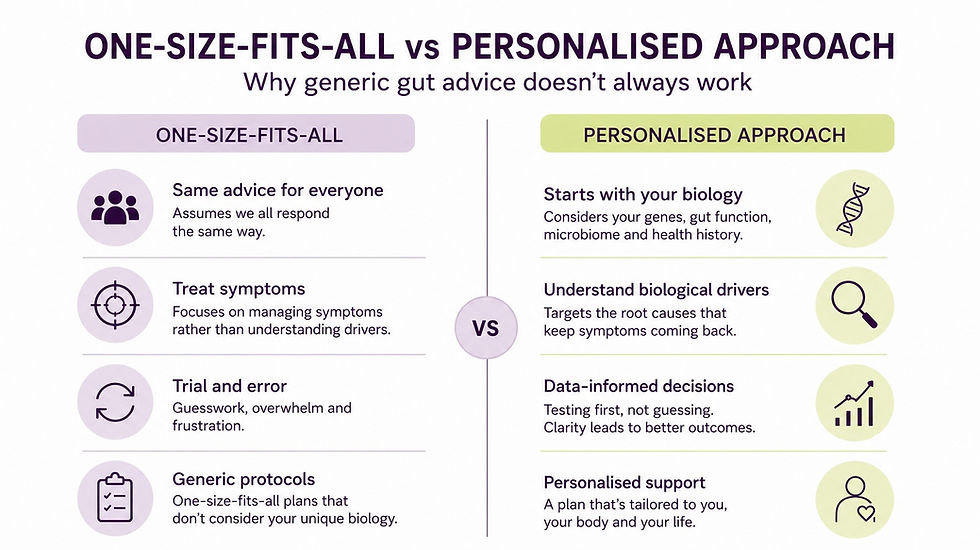
Looking beyond symptoms
Symptoms tell us what you're experiencing.
They rarely tell us why.
Two people can experience the same bloating, reflux or IBS-like symptoms while the biological drivers are completely different.
That's why I don't see genetic testing as the answer to chronic gut symptoms. I see it as one important piece of a much larger puzzle.
Within The Gut Rewire Protocol, DNA Gut testing is interpreted alongside comprehensive pathology, including thyroid function, nutritional status and metabolic markers, and advanced microbiome testing. Each explores a different aspect of digestive health. Together, they provide a far more complete understanding of what's happening beneath the symptoms than symptoms alone ever can.
The real value of genetic testing isn't that it tells you what's wrong. It's that it helps explain why your gut behaves differently from someone else's.
Once you understand that, you stop searching for the protocol that worked for someone else and start looking for the approach that's right for you.
Perhaps that's where truly personalised gut health begins.
What to remember
Your genes don't determine your gut health, but they do influence how your digestive system responds to food, stress, microbes and inflammation. |
People with similar digestive symptoms don't always share the same underlying biology, which is why the same diet, supplement or protocol doesn't work for everyone. |
Genetic testing isn't about predicting your future. It helps identify biological predispositions that can guide a more personalised approach to gut health. |
The most effective gut health strategies combine multiple sources of information. Within The Gut Rewire Protocol, DNA testing is interpreted alongside pathology and microbiome testing to build a more complete picture of what's driving persistent digestive symptoms. |
Continue exploring
If you'd like to explore the science behind genetics, the microbiome and personalised gut health, these are excellent places to start:
Genetics & personalised medicine
NHMRC – Genetics and Genomics – Explains how advances in genetics and genomics are shaping personalised healthcare in Australia.
National Human Genome Research Institute – Genomics and Medicine – An overview of how genetics is transforming modern healthcare.
The gut microbiome
CSIRO – The Key to Health Could Be in Your Gut – Explores the growing evidence linking the gut microbiome to health and disease from an Australian research perspective.
Human Microbiome Project (NIH) – Introduces the landmark research that transformed our understanding of the microbes that live in and on the human body.
Microbiome Research Centre (Australia) – Highlights current Australian research into the microbiome's role in immunity, inflammation, neuroscience and digestive health.
Exlore next
The Unexpected Link Between Leadership Coaching and Gut Health – How three decades in behaviour change shaped my approach to personalised gut health.
The Gut Rewire Protocol – Discover how DNA testing, pathology and microbiome analysis come together to personalise treatment for persistent digestive symptoms.


Do you offer genetic testing?