
Why Do My Gut Symptoms Keep Coming Back?
- 4 days ago
- 5 min read
5 Reasons You May Be Stuck in a Gut-Health Cycle
You change your diet. Things improve. You find a supplement that seems to help. Your bloating settles, your reflux quiets, your bowels become more predictable. Then, a few weeks or months later, you're back where you started.
Sound familiar? These are the symptoms that keep cycling, and the solutions that keep falling short.
🫃 Bloating After Eating
You've tried eliminating foods, adding probiotics, changing meal timing, and still the bloating returns.
🔥 Reflux or Heartburn
Antacids work temporarily, then stop. The burning keeps coming back.
😣 Constipation
More fibre. Different supplements. Adjusted routines. Yet here you are again.
⚡ Unpredictable Bowels
Diarrhoea, urgency, or irregular patterns that quietly reshape your entire day.
Each time symptoms return, you ask: What should I try next? But if you've already cycled through diets, probiotics, fibre, supplements, and elimination plans, there's a more useful question:
Why do I keep ending up back here?
Reason 1: You're Responding to Symptoms, Not the Bigger Picture
The Trap
Bloating leads you to remove a food. Heartburn leads you to reach for an antacid. Constipation leads you to add more fibre. Each decision makes sense in isolation, but none of them address the full picture.

The Reality
Persistent gut symptoms can be influenced by a range of factors, including:
Diet and eating patterns
Digestive function: stomach acid, enzymes, bile flow
Gut microbiome health
Genetics
Stress and nervous system state
Sleep quality and hormonal cycles
Medications and supplements
Ask instead: When do symptoms happen? What keeps bringing you back to the same place?
Reason 2: You're Changing Too Many Things at Once
You stop gluten, start a probiotic, increase fibre, and add several supplements. Then you feel better, but what actually worked? Or you feel worse, and it's impossible to know why. Without clarity, you can't learn from your experiments. You just accumulate more confusion.
1- Identify | 2- Clarify |
What symptom am I actually trying to change? | Why do I think this particular change might help? |
3- Define | 4- Review |
What would improvement look like? | When will I assess whether it actually made a difference? |
This cycle of trial-and-error can become a problem in itself, particularly when you're changing several things without knowing what is actually helping. Sometimes, you don't need to do more. You need to make fewer, better-targeted changes, and actually learn from the results.
Reason 3: Symptom Relief Isn't the Same as Resolution
Your bloating reduces. You get through dinner without heartburn. That feels like progress, and it is useful information. But symptom improvement doesn't explain why the symptom was happening in the first place.
When gut symptoms keep coming back, it's easy to conclude something has "stopped working" and move on to the next solution. This is the cycle.

The Shift That Matters
Instead of chasing relief, build understanding. Ask:
What changed when you felt better?
Why might that intervention have helped?
What does that tell you about what to explore next?
This distinction becomes crucial when gut problems have been going on for months or years.
Reason 4: You’re Eliminating More Foods, But Still Don’t Know What’s Driving Your Symptoms
One food seems problematic, so you remove it. Then another. Eventually you have a growing list of "safe" foods and a longer list of foods you're reluctant to eat.
Food restriction can sometimes have a therapeutic role. But continually eliminating foods without a clear rationale, timeframe, or reintroduction plan makes eating increasingly complicated, without answering the important question: Why am I reacting this way in the first place?
The Goal Shift
Instead of an ever-shorter list of foods that don't cause symptoms, aim for something more useful:
Understanding what's going on well enough to make informed decisions about what you eat.
A shrinking diet isn't progress. Clarity is progress.
Reason 5: You Have Information, But No Framework for You
You already know about probiotics, fibre, fermented foods, gluten, dairy, FODMAPs, fasting, and the microbiome. The problem isn't a lack of information, it's knowing what actually applies to you.
Eat more fibre
vs. Avoid fibre
Eat fermented foods
vs. Avoid fermented foods
Stop gluten
vs. Eat more wholegrains
Any of these recommendations might be useful in the right circumstances. That doesn't mean they're right for you. Your gut health is shaped by your own combination of biology, genetics, microbiome, health history, diet and lifestyle. Instead of asking "What's good for gut health?", ask:
What's actually happening in your gut?
What might your individual biology and genetics tell you?
What does your health history and other evidence add to the picture?
What makes sense to address first?
The Pattern You Might Not Notice
When you've lived with gut symptoms long enough, you don't just try different treatments. You start adapting your entire life around your gut.

Scheduling Around Symptoms
You book appointments in the afternoon because mornings are unpredictable.

Scanning Every Space
You notice where the toilets are before entering a room: automatically.

Pre-checking Menus
You read restaurant menus in advance and plan what's "safe" before you arrive.

Always Being Prepared
You keep antacids or other remedies nearby, just in case. Always.
These behaviours become so familiar you barely notice them. But they're quietly shaping your choices, your confidence, and your quality of life. This is where the approach must shift. It's not just about biology. It's about how living with symptoms has reshaped the way you eat, plan, socialise, and make decisions about your health.
A Different Approach: Physiology + Behaviour
This is where my background shapes the way I work. As both a clinical naturopath and registered psychologist, I look at the physiological picture alongside the behavioural patterns that can develop after months or years of living with persistent symptoms.
Persistent gut problems aren't solved by looking at biology in isolation. Nor should they be dismissed as "just stress."
Both physiology and behaviour matter.
Understanding Your Physiology
Symptoms, health history, diet, genetics, your microbiome, lifestyle, previous interventions, pathology, and, where appropriate, testing. Your individual picture is the starting point.
Understanding Your Patterns
How has living with these symptoms shaped the way you eat, socialise, research, and make gut health decisions? Breaking the cycle means addressing both sides of this equation.
Personalised Gut Health Care
This is the thinking behind The Gut Rewire Protocol, my personalised 14-week program for adults over 45 with persistent gut symptoms. It brings together health history, pathology, microbiome & genetic testing alongside a structured approach to behaviour change .
Before You Try Something Else
If you recognise yourself in this cycle, your next step doesn't have to be another diet, supplement, or list of foods to avoid. Start by looking at the pattern.
Which resonates most?
Which of the five reasons feels most familiar to your experience right now?
What's your loop?
What pattern have you been stuck in, and how long has it been going on?
What would change?
What would be different if you understood the why, instead of chasing the next solution?
The shift from "What should I try next?" to "Why do I keep ending up back here?" is where real progress begins.
If you’re curious about the pattern you may have fallen into, I created the Gut Pattern Decoder as a simple way to explore that question.
It’s a free 2-minute assessment that looks at how you've been approaching your gut health and helps identify which of four Gut Patterns you may have fallen into along the way.
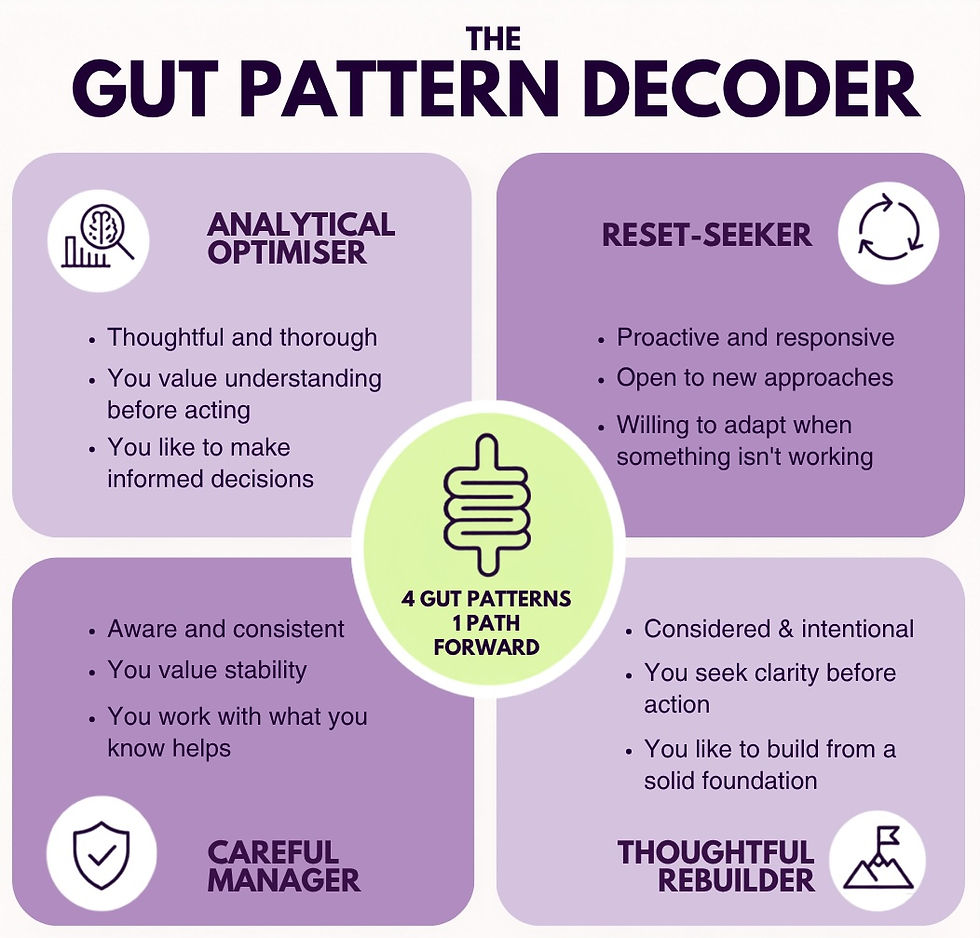
I personally review your responses and send you your individual Gut Pattern Report, so you can see your results in context.
No new diet. No new supplement. No list of foods to eliminate.
Just a different way to look at what may be keeping you stuck.


Comments